
Your Website is a Nomad, Not a Destination
Why AI search is rewriting the role of your domain

For two decades, websites were treated as destinations – places to attract visitors, hold their attention, and convert them inside the funnel.
That model still matters – but websites are now expected to function as sources whose content travels through the ecosystem, shaping discovery far beyond the URL itself.
Platforms like Google’s AI Mode and AI Overviews, ChatGPT, and Perplexity increasingly answer the query inside the platform itself. Users often get what they need without ever clicking through to a site.
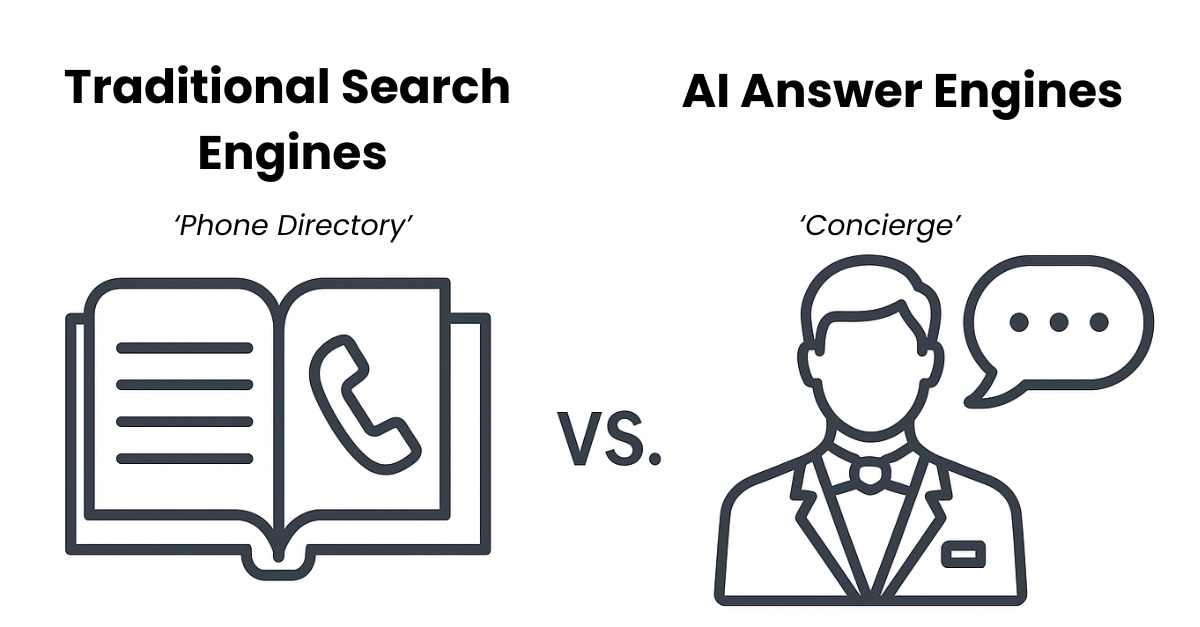
A website is no longer judged only by who visits or how long they stay. Its value is increasingly defined by whether machines can parse, trust, and cite it as a nomadic corpus of knowledge.
From containers to nomadic corpus
Old web – sites as containers, with funnels and navigation built to guide visitors.
AI web – sites as nomadic corpora, knowledge libraries disassembled and recombined into machine-generated answers.
The function shifts: from capturing attention to establishing machine-readable authority.
The new value chain
Old model: Content → Visitors → Attention → Conversion
AI model: Nomadic corpus → Machine trust → Citation → Branded search / Agentic action
Clicks don’t disappear – but influence now flows upstream into trust and citations, and downstream into branded behaviours and AI-driven fulfilment.
Signals that matter
AI systems don’t measure bounce rates or time on page. They assess:
Original insight – ideas and framing that add something new, not recycled content the machine has already seen.
Breadth of coverage – content that can answer a wide spread of related questions, so AI systems keep testing and surfacing it.
Depth in the niche – authoritative answers to specific, high-trust questions where expertise really matters.
Being cited – whether your content is directly referenced inside AI-generated answers.
Clear entities – unambiguous naming of people, organisations, and concepts, reinforced with structured data that machines can read.
Coherent architecture – a well-designed hub-and-spoke structure that presents your site as a connected body of knowledge.
These are the signals that determine whether machines surface your expertise – upstream authority that compounds into downstream human engagement.
Strategic implications
Websites are repositories before destinations – built to be parsed and cited.
Authority becomes portable – once trusted, it travels across platforms and queries.
Competition moves upstream – the fight is to be referenced, not just ranked.
Conversion shifts downstream – expressed in branded search, direct actions, and agentic fulfilment.
Upstream Trust, Downstream Impact
The website isn’t disappearing. But its purpose is expanding. It matters less as a closed destination – and more as the authoritative nomadic corpus from which AI systems extract the knowledge that defines your expertise.
We’ve tested this shift in practice through our Dual-Intelligence Architecture (DIA) model – showing how structuring content for upstream machine trust compounds into downstream human clarity and action.
👉 Read the full framework: Decoding Generative Engine Optimisation (GEO): The Emerging Principles of AI Search
About Media Collateral:
Media Collateral helps brands win visibility in the AI search era through structured content systems, behavioral insight, and editorial rigour. Founded by Andrew Tomison, a former journalist and behavioural economist-in-training, we specialise in building machine-readable authority and downstream human engagement – turning expertise into content AI trusts and people act on. Learn more at mediacollateral.com